

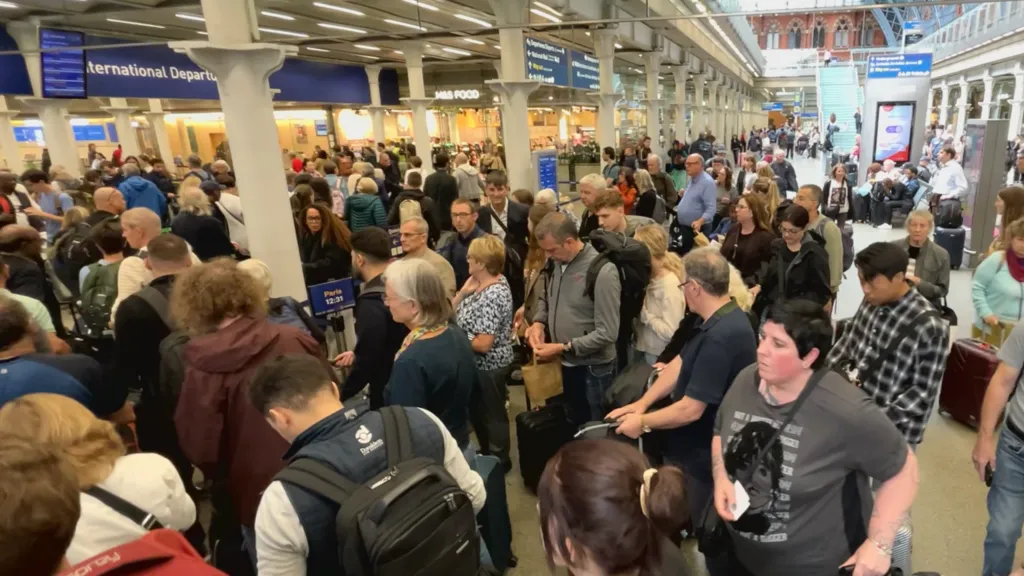
 People wait to go through departures at Eurostar's London St Pancras terminus
The next time you travel from the UK to Europe, you might notice some changes.
The EU's new digital border system, the Entry/Exit System or EES, is being gradually introduced, to strengthen security and ultimately make travel smoother.
However, there have been incidents of long queues at European airports and warnings that things could get worse during busy holiday periods.
EES is a digital system designed to keep track of when non-EU citizens - including those from the UK - enter and leave the Schengen Area.
This covers 29 European countries - mainly in the EU - which people can travel across without border controls.
It includes many popular destinations for UK travellers, such as France, Spain, Portugal, Italy and Greece.
Under the new system, fingerprints and a photo have to be registered.
EES will eventually replace the current system of passports being stamped by a border officer.
The gradual introduction of EES began on 12 October. The plan was to phase it in over six months.
EES should be active at every Schengen border crossing point in all 29 participating countries by 10 April.
When you first encounter EES will depend on where you're travelling to, and when.
If you're flying, you will go through the process when you land at European airports. However, only about a third of non-EU passengers are required to do so at the moment.
There have already been hours-long queues at pinch points. Airports have warned things could get worse over upcoming holiday periods.
However, the European Commission has indicated that suspending EES checks to help ease queues will be allowed at busy times until September.
The first time they use the new system, people from most non-EU countries will have to register biometric information while having their passport scanned.
Flight passengers will register at their destination airport.
But if you are crossing the English Channel by ferry from the port of Dover, taking the Eurotunnel shuttle to France, or getting the Eurostar train, it will be done as you leave the UK.
At these places, most passengers will have to follow the instructions at special kiosks.
The machines will scan each passport, then take fingerprints and a photo.
Children under 12 won't have to provide fingerprints. Staff should be on hand to help.
The screen will also present travellers with four questions about their trip, such as confirming where they will be staying and that they have enough money.
However, at Eurotunnel, those questions will be asked by border officers, on a discretionary basis.
The EES registration will be valid for three years, with the details verified on each trip during that period.
At Dover, ferry passengers in coaches started using the new system in October. Other tourist traffic was initially meant to follow on 1 November.
However, people in cars have still not begun using it, with no date yet confirmed.
Eurotunnel, which runs vehicle shuttles through the Channel Tunnel, is also introducing the EES in stages.
At the port of Dover and Eurostar's London St Pancras terminal, the questions will also not be presented on the machines during the introductory period.
Big changes have had to be made at Dover. The port has reclaimed some land from the sea to create an additional processing area.
People will head to this new area, a mile from the ferry terminal, to do their EES checks.
Because the French border has in effect been moved to a coach processing building in this new area, coaches will be sealed after passengers have completed their checks. They will then drive over to catch their ferry.
The port's boss says groups of schoolchildren will be able to do some of their registration in advance, so they will only need to present their passports at the border.
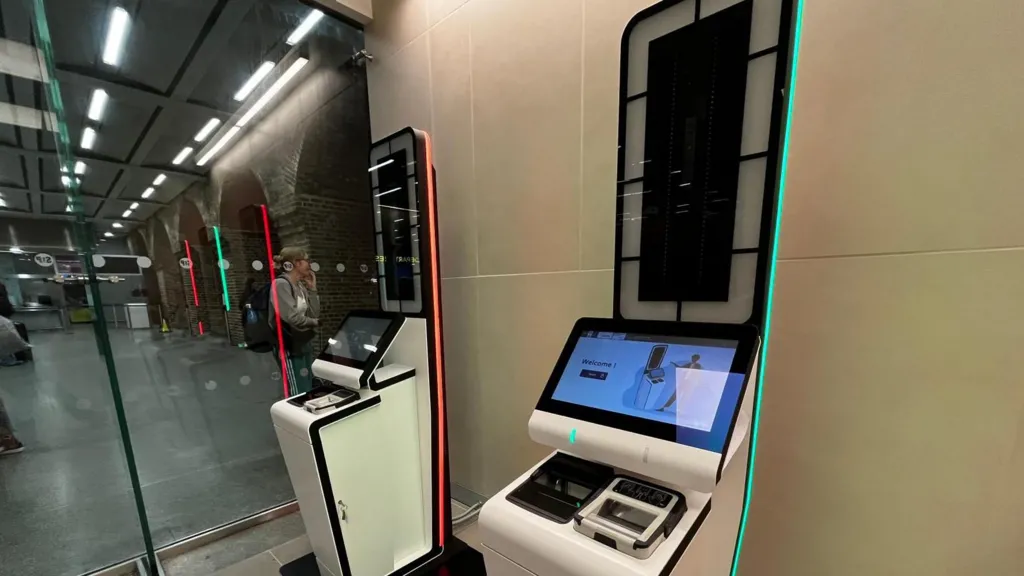 Eurostar has already installed 49 EES processing machines at London St Pancras
Eurostar has installed 49 EES kiosks in three areas around its London St Pancras terminal. Passengers will use them before presenting their ticket at the departures area.
However, checks are currently being completed manually by border officers, not at the machines. Eurostar says it will bring in the kiosks "once the operational software and the activation timetable are confirmed and approved by the French Ministry of Interior".
Eurotunnel has installed more than a hundred kiosks at each side of the Channel.
Customers who are travelling in cars will be directed to drive up to a kiosk bearing their registration number, and provide their biometric information there. Coach passengers will go through the process with a border officer.
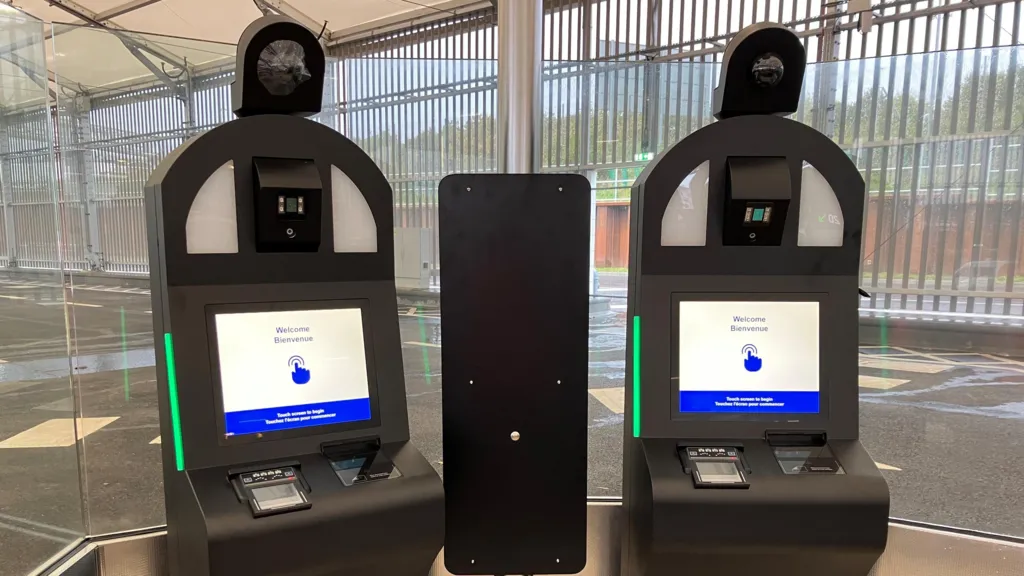 Eurotunnel has installed more than a hundred EES kiosks at each side of the English Channel
A mobile phone app has been developed to enable passengers to do part of the process before reaching the border. However, this isn't being widely used at the moment.
Concerns have repeatedly been raised that the extra couple of minutes it takes for each traveller to complete the registration process could lead to big queues, particularly at space-constrained Dover.
However, bosses at cross-Channel travel hubs hope that the decision to introduce EES gradually, instead of with a "big bang" start, will reduce the risk of disruption.
Eurotunnel chief executive Yann Leriche says there will be no "chaos" or queues at the Channel tunnel and that his company is fully prepared.
Similarly, Eurostar hopes its decision to limit EES initially to some business travellers before expanding its use will help prevent queues.
The EU is also introducing a new visa waiver system linked to passports called the European Travel Information and Authorisation System (ETIAS), which will build on the EES.
Citizens of non-EU countries who don't need a visa to enter the EU - including people from the UK - will be able to apply online for authorisation before they travel.
ETIAS isn't due to start until the end of 2026, but the final date has not yet been confirmed.
It will cost €20 (£17.47) per application, and will be valid for three years.
People aged under 18 and over 70 will need to apply, but won't have to pay.

Is dining out dying out?
The restaurant industry says it is facing a double whammy - rising costs and customers with less money.(2 )Readerstime:2026-02-14
Heathrow not crowded but peopl
Chief executive Thomas Woldbye says Europeans and Brits keep "crashing into each other" because they walk on different sides.(2 )Readerstime:2026-02-14
Inflation eases in US as price
Prices rose by 2.4% in the year to January, the latest official figures show, the slowest pace since May.(2 )Readerstime:2026-02-13
Hello Kitty designer steps dow
Yuko Yamaguchi oversaw the feline character‘s rise to to global icon status.(2 )Readerstime:2026-02-13US jobs see surprise growth in
 Employers added a greater than expected 130,000 jobs in January, according to the latest figures.2026-02-11
Walmart becomes first retailer
 The milestone reflects the US retail giant‘s booming e-commerce business and investors‘ embrace of its AI investments.2026-02-04
Why Target is under fire over
 Workers are writing letters, staging strikes and in some cases resigning over how bosses are handling the immigration crackdown.2026-02-05
Reeves says 'more to do' after
 The chancellor‘s comments came after figures showed the UK economy saw a lacklustre end to 2025.2026-02-12