

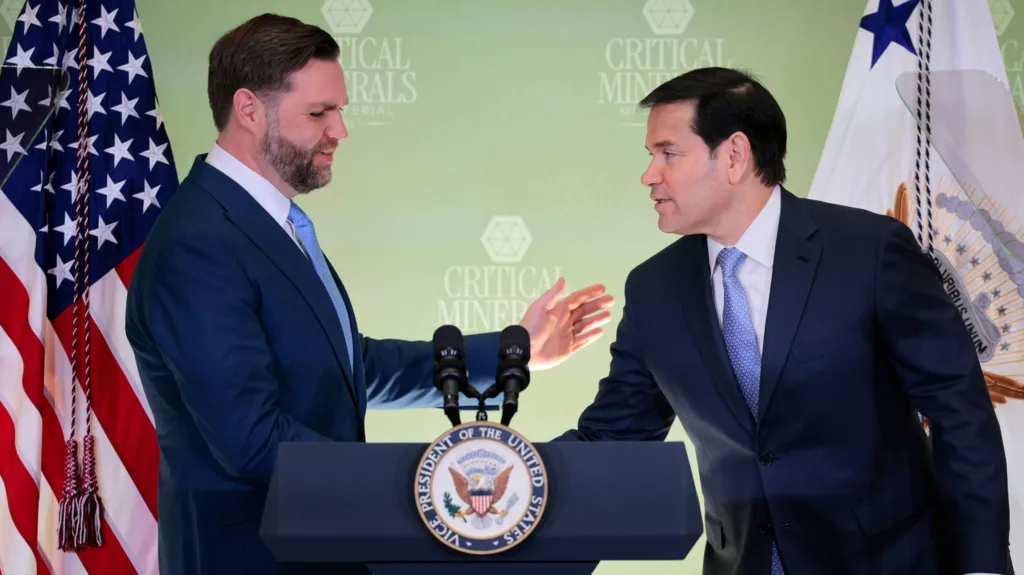
 JD Vance and Marco Rubio at the first Critical Minerals Ministerial event on Wednesday
The US has launched an effort to form a trade zone for critical minerals that are key to making everything from smartphones to weapons as it tries to break China's dominance of the industry.
On Wednesday, the State Department hosted the first Critical Minerals Ministerial event - which was attended by countries and organisations including the UK, European Union, Japan, India, South Korea, Australia and the Democratic Republic of Congo.
Delegates discussed the availability of and access to minerals crucial to the manufacture of things like computer chips and electric vehicle batteries.
The mining and processing of such critical minerals, which include rare earths, is dominated by China.
In remarks released by the US government, Vice President JD Vance and Secretary of State Marco Rubio did not mention China by name.
Instead, Vance referred to the "foreign supply" of such minerals flooding global markets, making it difficult for other countries with mineral deposits to secure the financing needed to produce them.
The US planned to use tariffs to stop critical mineral prices falling too low, which can deter investment, he said.
David Copley, a special assistant to President Donald Trump, said the US intends to "deploy hundreds of billions of capital into the mining sector to get projects going".
Investments have already been made in several companies, including rare earths magnets maker MP Materials and Lithium Americas, which produces material key to rechargeable batteries, he said.
US Trade Representative Jamieson Greer also said that the US, Japan and the European Commission are developing "coordinated trade policies and mechanisms" in order to collectively avoid potential issues with access to important minerals.
Ahead of the meeting, a Chinese Foreign Ministry spokesperson said "countries need to follow the principles of market economy and international economic and trade rules, step up communication and dialogue".
The event was part of a broader effort by the US government to counter China's ability to use its dominance of the industry as leverage in trade negotiations.
On Monday, Trump announced the creation of a critical mineral reserve, called "Project Vault", worth almost $12bn (£8.8bn).
Industry figures welcomed the announcement.
"It's critical to see the United States take decisive steps to shore up our supply of all kinds of minerals and rare earths," said Wade Senti, president of Advanced Magnet Lab.
Wednesday's event took place on the same day that Trump had a phone call with his Chinese counterpart Xi Jinping, which the US president described as "very positive."
China has a chokehold on rare earths and has tightened its grip over exports in recent months.
Beijing requires companies in China to get government approval before shipping the minerals abroad.
When the curbs were tightened in October it dealt a major blow to the US, whose industries are heavily dependent on these imports.
The Chinese government soon eased those stricter measures but analysts say it is using its dominance as a key bargaining chip in trade talks with Washington.

Is dining out dying out?
The restaurant industry says it is facing a double whammy - rising costs and customers with less money.(2 )Readerstime:2026-02-14
Heathrow not crowded but peopl
Chief executive Thomas Woldbye says Europeans and Brits keep "crashing into each other" because they walk on different sides.(2 )Readerstime:2026-02-14
Inflation eases in US as price
Prices rose by 2.4% in the year to January, the latest official figures show, the slowest pace since May.(2 )Readerstime:2026-02-13
Hello Kitty designer steps dow
Yuko Yamaguchi oversaw the feline character‘s rise to to global icon status.(2 )Readerstime:2026-02-13Sarah Ferguson asked Epstein f
 Emails appear to show the desperate measures Ferguson considered to rescue her finances.2026-02-12
Pandora to switch from silver
 The jeweller says it wants to reduce its exposure after the cost of the precious metal has risen.2026-02-06
Target slashes 500 jobs as ret
 Executives said the reductions were part of a restructuring meant to help fix stagnant sales.2026-02-10
US antitrust chief resigns ami
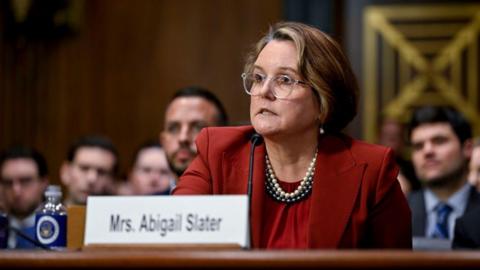 The departure of Gail Slater has raised questions about the White House‘s approach to policing big mergers and monopolies.2026-02-13