

It is first thing in the morning and nurses are waiting to take Michael Robinson to theatre.
He has been living with atrial fibrillation (AF), a common heart rhythm problem, affecting 1.4m people in the UK, that can cause your heart to beat irregularly and often too fast.
"It's very debilitating. On my worst day I feel very tired, my heart rate increases rapidly - I could walk for 2 or 3 miles and be okay, I could walk for 100 yards and it would hit me."
Michael was diagnosed five years ago after his younger brother died from a heart issue, but is hoping new cutting edge treatment will dramatically improve his quality of life.
Belfast's Royal Victoria Hospital is the first hospital in the UK to trial the Volt Pulsed Field Ablation System (VPA), a procedure which stops irregular heart rhythms when medication fails.
"I got quite a shock when I was diagnosed as I had been pretty active but after my younger brother died, we all got checked out and I was diagnosed with AF five years ago, I'd never heard of it," Michael said.
Michael added: "I was to go on holiday and had to pull out and recently attended a wedding reception but had to come home after half an hour, hopefully this treatment will normalise things for me."
There are several benefits to VPA, including allowing more patients to be treated each day – up to three - as opposed to one and quicker recovery.
As patients are placed under conscious sedation an anaesthetist isn't required.
Patients are also admitted and discharged on the same day, freeing up valuable hospital beds.
"It's a wee bit scary, but I've a lot of faith in the staff," the 67-year-old said as he went to theatre.
A normal heart rate should be between 60 and 100 beats per minute, but in people with AF it can be considerably higher than 100.
The progressive condition can increase the risk of stroke and heart failure.
Symptoms include a fast, irregular, or pounding heart (palpitations), dizziness, fatigue, shortness of breath, and chest discomfort.
It's estimated that many are living with the condition undetected and unaware of the health risks.
Episodes may start suddenly and last from seconds to days, sometimes causing no symptoms at all.
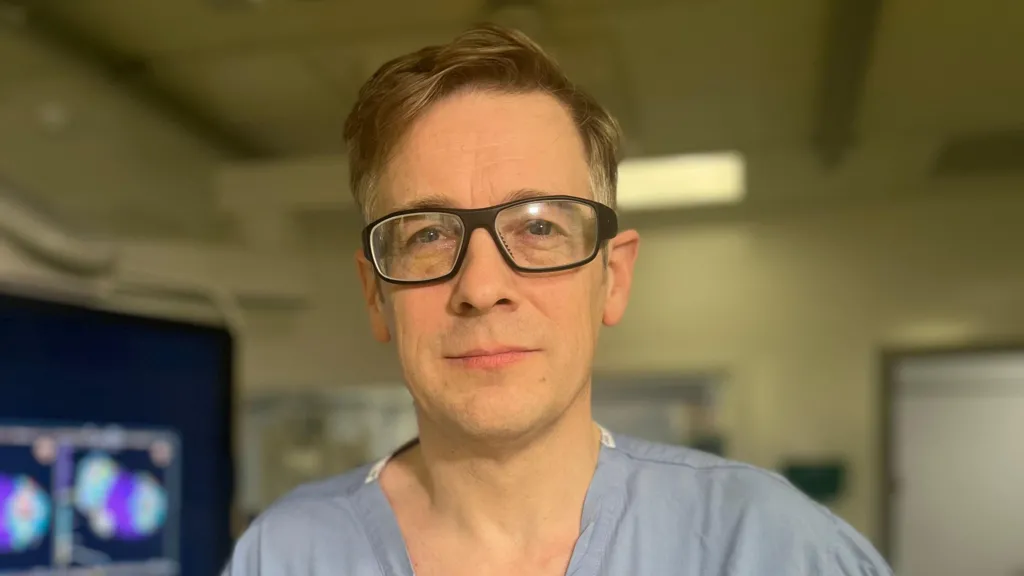 Dr Nick Cromie has performed the treatment at RVH
Sixty patients have been treated at the RVH during the trial, which started in September.
"This benefits the hospital when it comes to patient flow and addressing waiting lists, also there is no need for an anaesthetist which is good as there is a global shortage of specialists," Dr Nick Cromie, a cardiac electrophysiologist, said.
Cromie explained that the Volt PFA System uses high energy electrical pulses to precisely target and treat abnormal cardiac tissue.
This minimises the risk of damage to surrounding structures such as the oesophagus or blood vessels.
"This system is a big step forward in both patient safety and the hospital being a lot more efficient with its staff and use of theatre time," he said.
One of several consultants at the RVH who is carrying out the procedure, Cromie said it's all about preventing more serious illness like stroke and heart attack.
"We entered the blood stream at the top of the inner thigh and then travelled up through the blood stream all the way up to Michael's heart - where we punctured a small hole to access the chamber where the problem is and then inflated a small balloon.
"That helps us conduct electrical signals in the catheter into the heart tissue which needs treated," he explained.
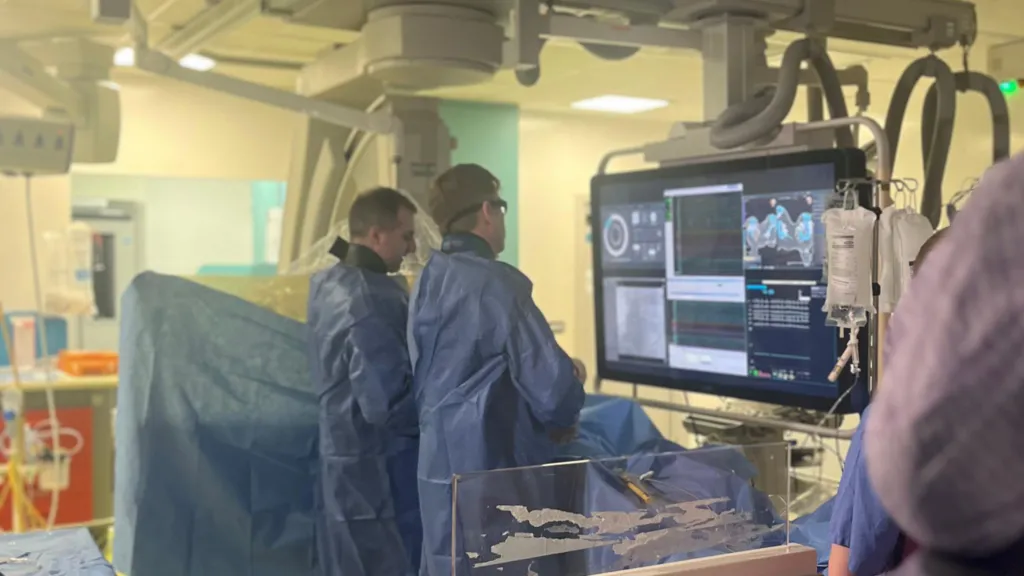 A patient being treated can be in and out of hospital within the day
After a pilot in Belfast some hospitals in England are rolling out the Volt PFA system, which was created by the global healthcare company Abbott.
Dr Riyaz Somani, consultant cardiologist at the University Hospitals of Leicester NHS Trust, was the first electrophysiologist in England to use the new system.
"Our initial experience has been overwhelmingly positive, with all patients tolerating the procedure very well with excellent acute success rates," he said.
Michael had previously been treated using cryotherapy, a minimally invasive procedure in which small areas of heart tissue causing irregular heartbeats are frozen and destroyed, however, patients often experience discomfort including gastric upset.
Also, many don't experience a full recovery.
Seven hours after being taken to theatre Michael is ready to go home.
"The Royal Victoria Hospital has been so good to me - I am feeling much better already – in fact I might even go and play a game of football," he said laughing.

'My mum took the pressure off
Actress Wunmi Mosaku is nominated for an Oscar for her role as Annie in the vampire horror Sinners.(0 )Readerstime:2026-02-15
Gallery's entire art collectio
The art gallery‘s bosses say it is people‘s first opportunity in decades to see the full collection.(0 )Readerstime:2026-02-15
The Instagram-friendly shoppin
Merry Hill is using leisure and entertainment to increase its customer base, the manager says.(0 )Readerstime:2026-02-15
Should stolen Shakespeare foli
The damage caused when Durham‘s First Folio was stolen remains - for now.(0 )Readerstime:2026-02-15Migrant boat capsizes off Liby
 The IOM says that almost 500 people have been reported dead or missing off Libya so far this year.2026-02-09
From classroom to camera: A te
 At 70, indigenous teacher Biana Watre Momin acted in an Indian film that has changed her life.2026-02-08
Shaheen Malik: An acid attack
 Malik recently petitioned India‘s top court to include survivors forced to ingest acid under disability law.2026-02-11
Chris Mason: Another defection
 Both of Westminster‘s mega brands, Labour and the Conservatives, are feeling discombobulated, the BBC‘s political editor writes.2026-01-27