

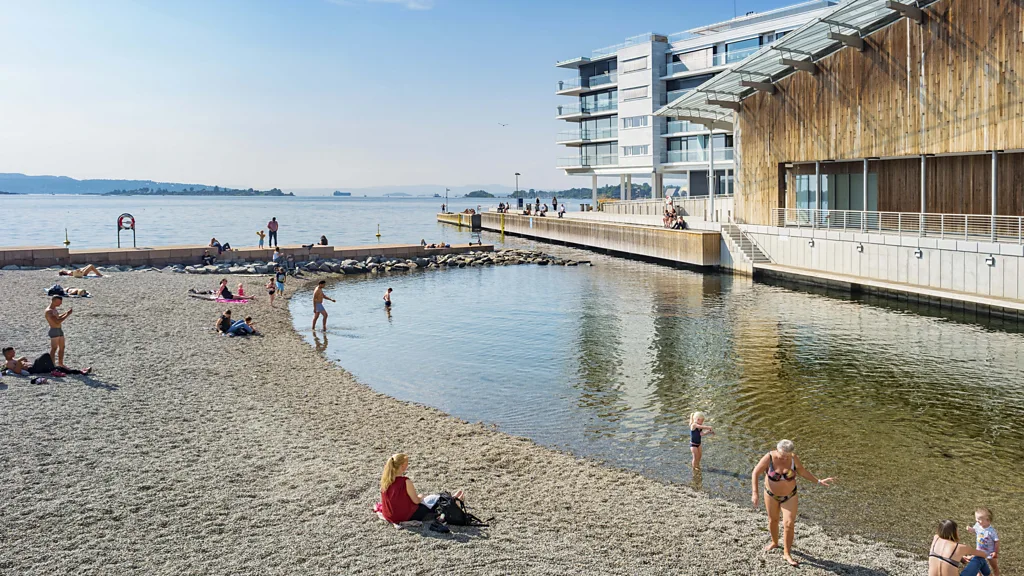
In Oslo's Vulkan neighbourhood, sustainability, style and everyday ease come together in a way that's making the Norwegian capital feel like Europe's most liveable city break.
If you're after a city break that combines culture, comfort and quiet innovation, Oslo might surprise you. Barely a two-hour flight from Heathrow, the Norwegian capital offers something unexpected: a relaxed, walkable escape where everyday life is designed for ease, from all-electric transport to sustainable neighbourhoods. In short, the perfect city for me to explore on my daylong layover.
I started my 24-hour Oslo immersion in the pocket-sized Vulkan neighbourhood, a once-derelict industrial site that has become one of Europe's most forward-thinking micro-communities. Set on the banks of the Akerselva river, Vulkan is packed with art, culture and delicious food – something of a microcosm of Oslo itself. As soon as I arrived, the main square buzzed with friends catching up over coffee, people enjoying a mid-afternoon stroll and vendors hustling provisions through the streets in preparation for the dinner rush. Ringed by a food hall, a concert venue, a climbing gym and a dance theatre, Vulkan felt like a city within a city.
Vulkan wasn't always this welcoming. Just 20 years ago, this riverside plot in central Oslo was a derelict tangle of concrete and broken windows. Today, it's a compact urban village powered by geothermal energy, cooled with rooftop solar panels and home to community-driven cultural spaces. Designed with a focus on density, design and sustainability, Vulkan is a model for how cities can rethink old spaces to create new futures. And, as I'd learn over 24 hours, it's also a gateway to understanding the quiet innovation at the heart of Norway's capital – a place where liveability is taken seriously.
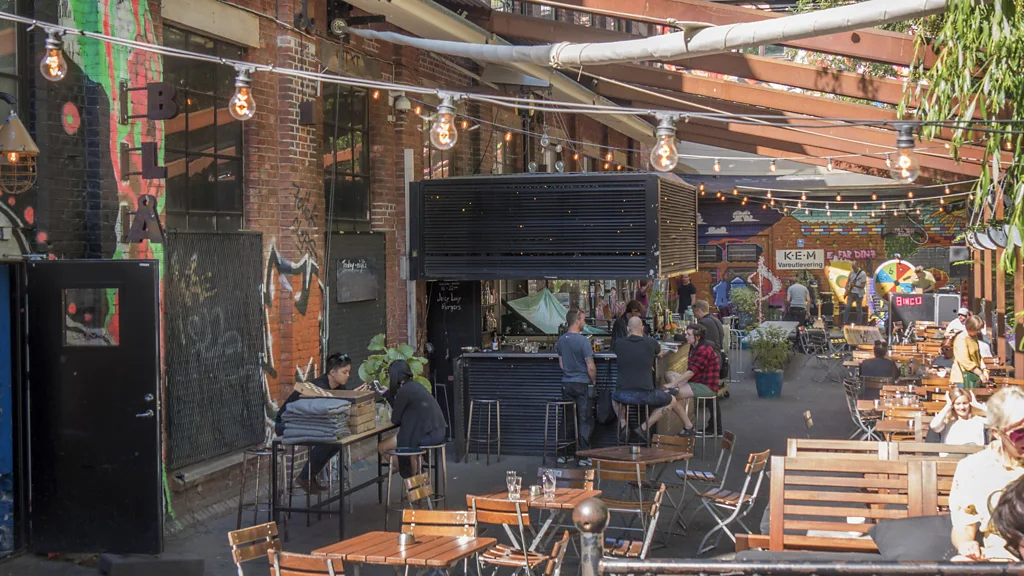 Oslo's Vulkan neighbourhood has become one of Europe's most forward-thinking micro-communities (Credit: Didrick Stenersen/ Visit Oslo)
While the hip, vibrant life is a recent development, the neighbourhood dates to the Middle Ages, when it was a longstanding trading hub. During the industrial revolution of the mid-19th Century, the area evolved into a manufacturing centre, where several of the city's foundries could be found. Then, in 2004, after much of the neighbourhood's industry had vanished and the once-thriving Vulkan Factory – so named for Vulcan, the Greek god of fire and handiwork – closed, morphing into simpler warehouse space, city officials asked themselves: why not build a city within a city, one that can re-envision what a cities of the future can and should look?
The project started in 2004 when a pair of property developers – Aspelin Ramm and Anthon B Nilsen – purchased the land that would become Vulkan; land that was, at the time, severely blighted.
"Kids were not allowed to play here," said Sverre Landmark, a former commercial director for Aspelin Ramm. "Glass windows were damaged, there was a lot of graffiti, drug addicts were hanging around. It was really nasty."
Within a few years, Vulkan started to take shape. By 2008, the country's national contemporary dance theatre, Dansens Hus, had opened on the fast-developing square. In 2012 came neighbourhood cornerstone Mathallen, Norway's first food hall, located in a former cast iron factory. Today, Mathallen boasts more than a dozen restaurants, bars, bakeries cafes and shops: my dinner there included a dozen oysters from a fishmonger, a pair of small pork bao, a plate of homemade cacio e pepe pasta and a few locally brewed beers. Just steps away, Vulkan Arena, a 950-capacity music venue that has hosted artists such as Kim Gordon of Sonic Youth, indie rock stalwarts Mercury Rev and long-running metal band Downset, adds even more cultural clout.
But Vulkan isn't just buzzy, it was built to be sustainable. A series of 300m-deep geothermal wells lie deep beneath the square and the low-rise buildings above it. Along with the ubiquitous solar panels, Vulkan can create almost all its own heat during the long, cold winter and cooling throughout the country's abbreviated summer. Meanwhile, eco-friendly architecture includes a neighbourhood-defining office building with an exterior solar array used to heat the building's water. And rising above the square, a few steps up a wide staircase, is the 149-room Scandic Vulkan, an uberhip, design-focussed hotel that is Norway's first energy class A hotel, the highest energy efficiency rating awarded by the European Union.
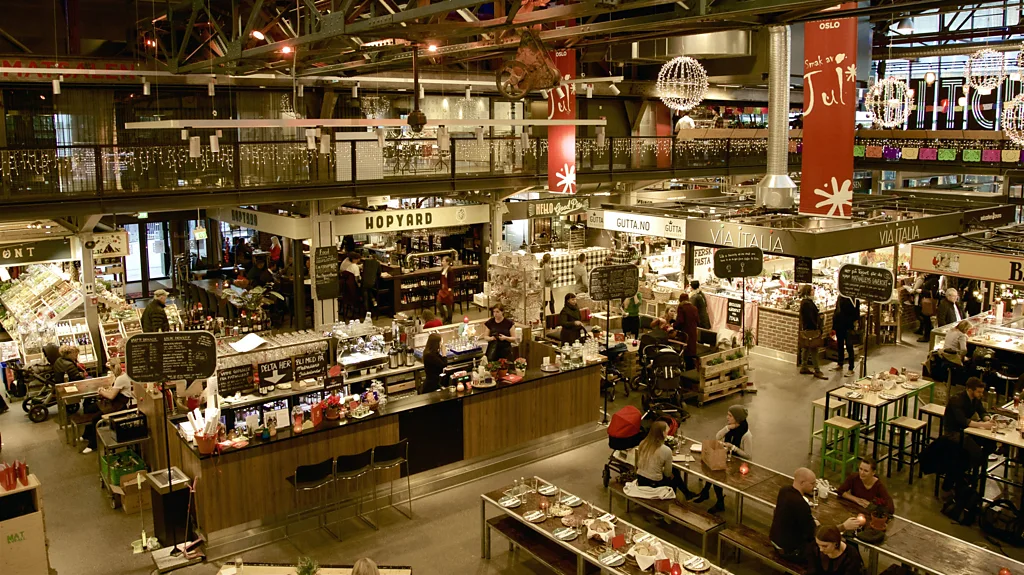 Mathallen, Norway's first food hall, is a cornerstone of the neighbourhood (Credit: Susanne A Finnes/ Visit Oslo)
Even the rooftops play their part. The Vulkan Apiary – a pair of 3m-tall beehives – was started in 2014 in an effort to repopulate the once-thriving bee population along the Akerselva. And while you can purchase the honey from just about anywhere in Oslo, it's enjoyed at its most fresh just a few metres away at Mathallen.
The fact that all of Vulkan exists across just 9,400sq m, or roughly one city block, makes the neighbourhood a model for easy, sustainable living. Just like the square itself, the whole of Vulkan feels as if you could simply reach out and touch each of its corners, to enjoy each of its various elements in just a few short hours.
More like this:
• Sweden's wooden city that was green before Greta
"Vulkan arrived as something entirely new, in a hidden spot in Oslo, and helped to make the city larger while shortening the distance," Landmark said. "Vulkan provided content and substance and created opportunities for some of the many entrepreneurs who in the last 10-20 years have created a truly special Oslo feeling."
Locals agree: "Vulkan is part of the new Oslo vibe," said Fredrik Remøy, a finance professional who lives in Oslo with his family. "It's very relaxed and international. It's offered a bit of warmth and a buzz to the city."
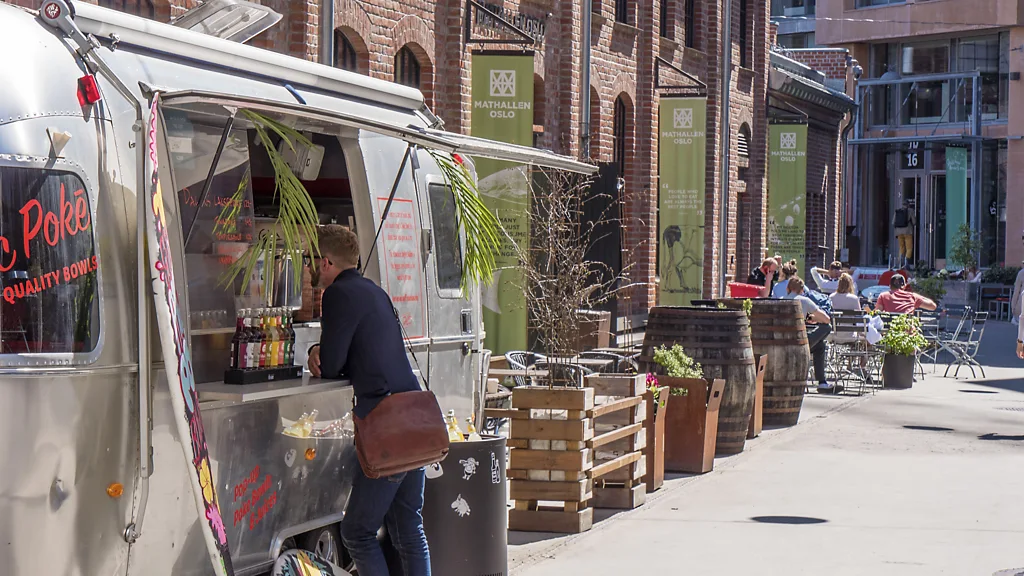 Oslo offers travellers a relaxed, walkable city break where everyday life is designed for ease (Credit: Didrick Stenersen/ Visit Oslo)
And while it may be a microcosm, Vulkan's development has hardly happened in a vacuum, as both Oslo and Norway at large have long been at the forefront of sustainability efforts, designing and developing with our planet's future at the fore.
Walking around Oslo's compact city centre, one of the most pleasantly jarring things you notice is the lack of vehicle traffic. Streetcars rumble by, as do city buses and taxicabs and plenty of cyclists pedalling their way over the streets. Passenger vehicles appear to be refreshingly limited. The absence of traffic makes the city feel calm and spacious; even in the middle of the bustling metropolis, Oslo's atmosphere feels more open than a typical city.
In this sense, it's easy to see Vulkan as the fingerprint of a wider ethos and a grander aim. If a neighbourhood can be built to be fully sustainable, why can't an entire city? If an entire city, why not a whole country? If a whole country, what about our society? Zooming out from Vulkan, it seems that Norway is asking the same kinds of questions.
After all, this is a nation that has set an ambitious goal of carbon neutrality by the year 2030 and net-zero emissions by 2050.
As my day in Oslo neared its end, I figured I had to enjoy one of the city's iconic activities. After all, in a city whose viral 2024 ad campaign encourages tourists to "life-see" rather than "sightsee", I had to do as the locals do. And so, after a 10-minute cab ride (in an exhaust-free electric taxi, of course), I found myself in the Bjørvika neighbourhood, which, like Vulkan, is one of Oslo's new developments focused on multifunctionality, density and creative use of existing space.
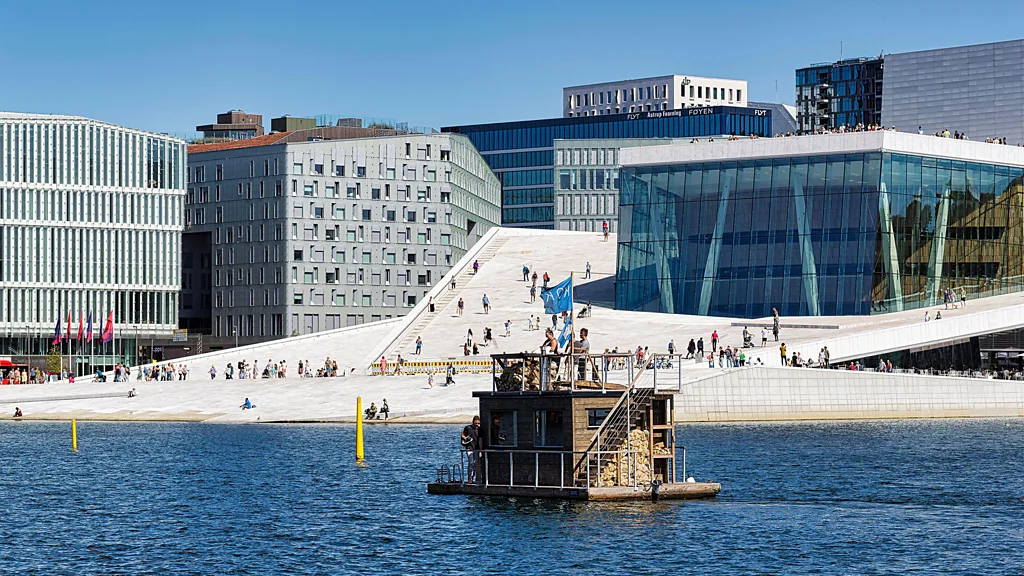 Oslo's floating saunas offer a bracing Nordic ritual in the heart of the city (Credit: Alamy)
I crossed a narrow gangplank as the bright lights from the nearby Munch museum reflected off the surface of the city's main waterway, the Oslofjord. Here, I spent a few hours in a self-service, wood-sided floating sauna, inside which it was nearly 80C. A cloud of steam puffed above my overheated body as I made my way into the frigid inlet, whose temperature was somewhere in between the sauna and the night sky. Over the course of the two-hour reservation, I took some five or six turns between sweating and dipping, reflecting on just how seamlessly Oslo encourages a life well lived.
Just 12 hours after I'd arrived, I already felt an easy kinship with the city. Perhaps it was the calm streets or the way Vulkan distilled so much of Oslo's essence into a single square. In a world of frenetic city breaks, Oslo offers something rare: clean air, a slower pace and a blueprint for the cities of tomorrow.
CORRECTION: A previous version of this article incorrectly stated that petrol-powered engines have been banned in Oslo's centre since 2017. This has now been updated.
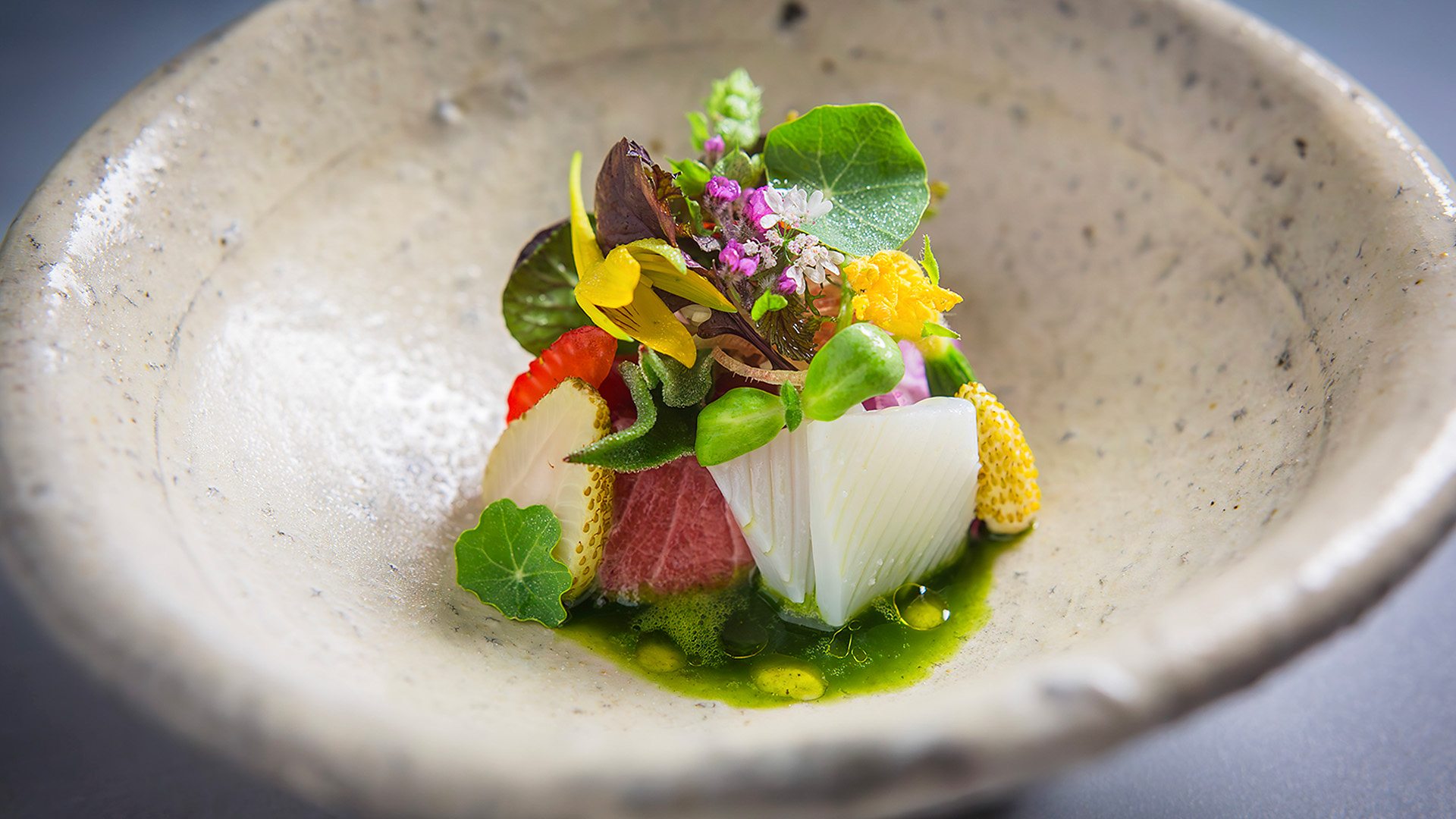
The most anticipated restauran
From flame-seared dishes in Mexico to avant-garde cooking in India, these six new restaurants are worth travelling for this year.(2 )Readerstime:2026-02-14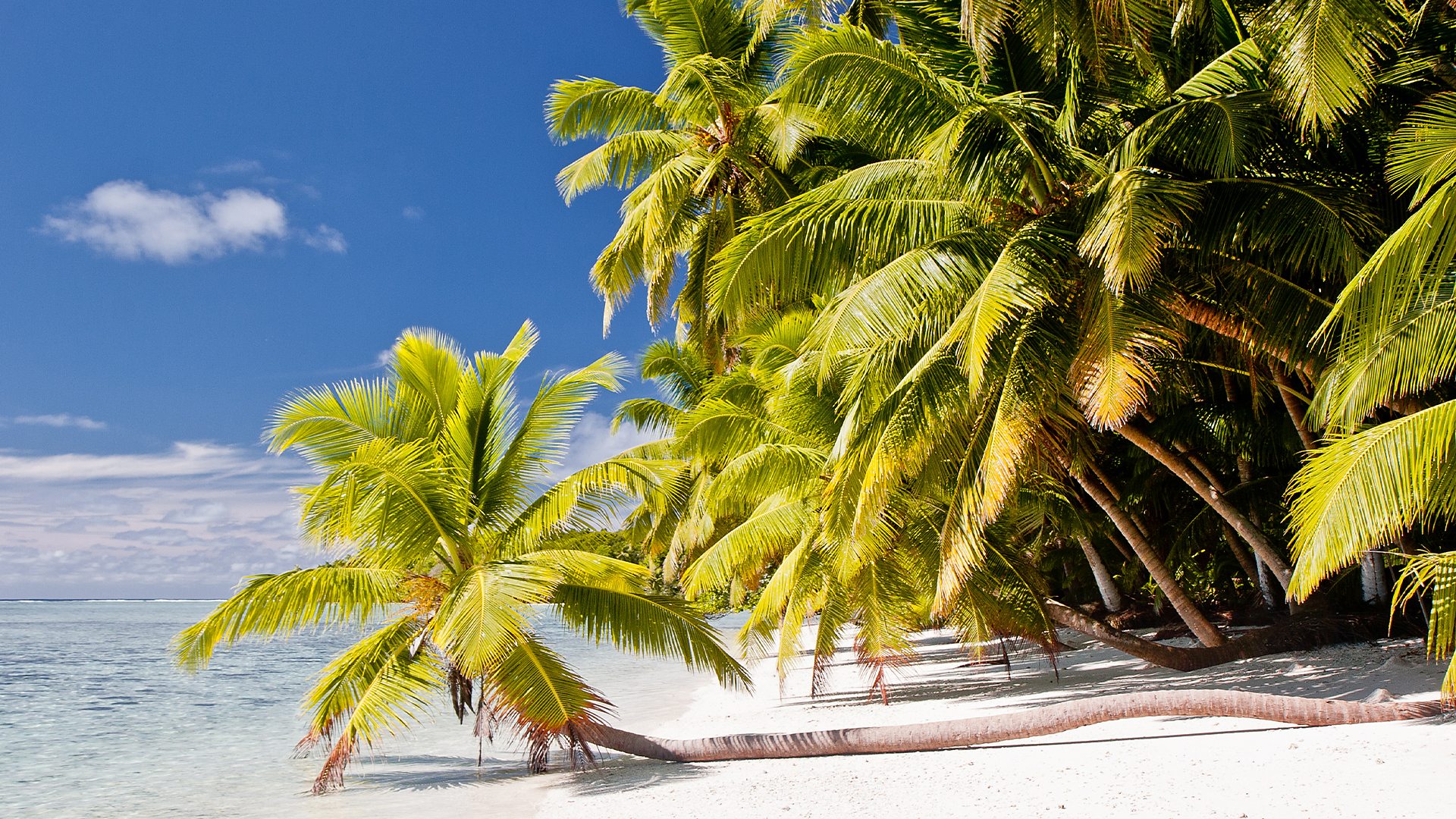
The secretive islands behind t
Remote and off-limits to tourists, Chagos is a paradisiacal slice of the tropics that‘s home to one of the most pristine reef systems on Earth. So why are they ...(2 )Readerstime:2026-02-13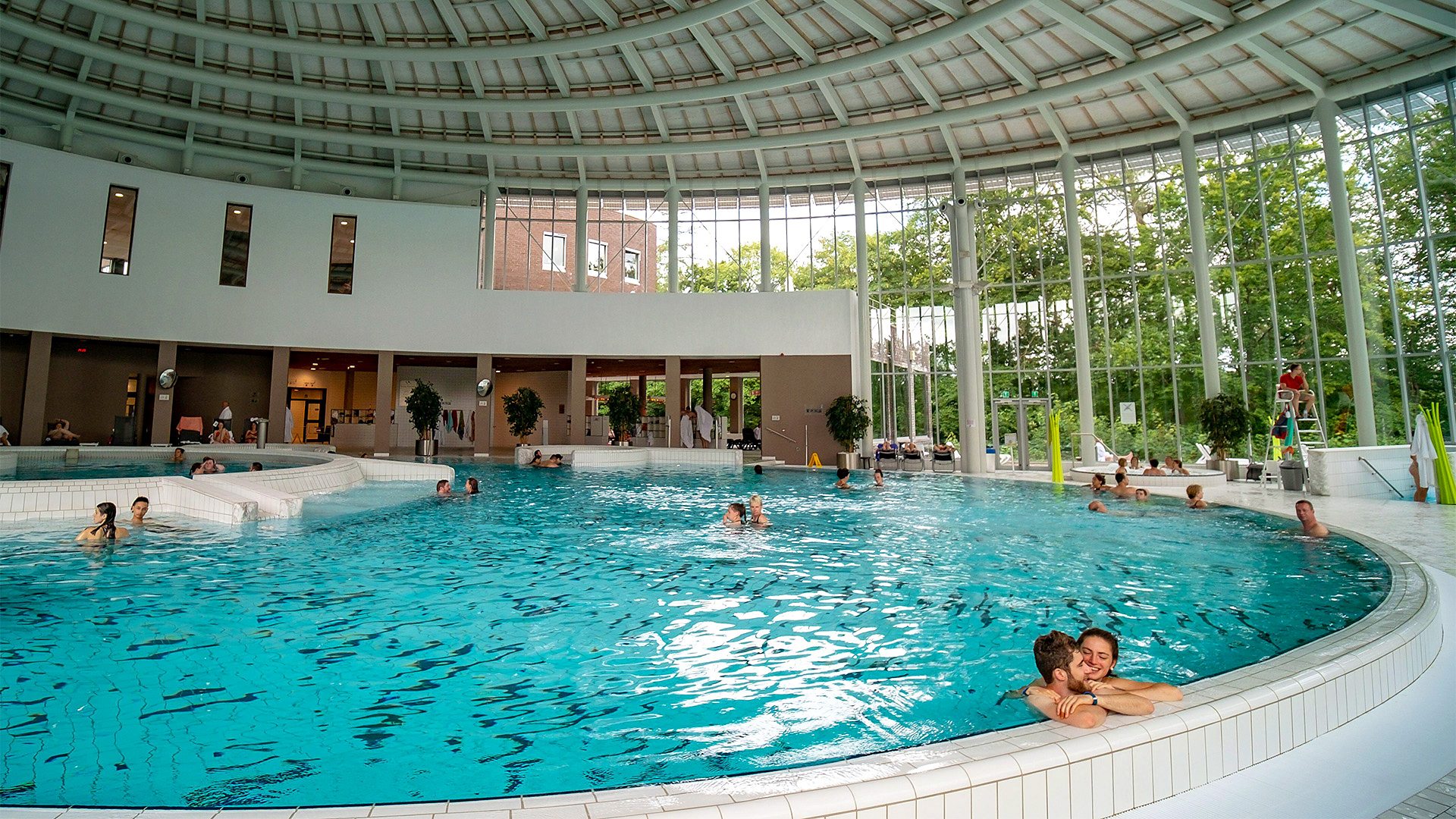
The town that launched a globa
Long before wellness became a global industry, a small town in eastern Belgium shaped how Europeans thought about health, leisure and water.(2 )Readerstime:2026-02-12
Where to elope in 2026
Once furtive affairs, elopements now happen in spectacular destinations and have become an increasingly popular way for couples to embark on the adventure of ma...(3 )Readerstime:2026-02-11An aurora chaser's guide to th
 Experts say 2026 will be a peak year for aurora spotting. Photographer Wil Cheung has seen the borealis more than 400 times and offers his tips on how to witnes...2026-01-24
Seven new Bridgerton filming l
 Bridgerton is back, and from London palaces to Bath ballrooms, here are some of the best places to experience Regency-era England.2026-01-26
How Trump is disrupting global
 Some travellers are now second-guessing whether it‘s safe to visit destinations the US has recently threatened.2026-01-12
Is it time to retire terms lik
 From "Venice of the East" to "lost civilisations", colonial-era travel metaphors still shape how some see non-Western places. But that language deserves a rethi...2026-01-21